
Forest destructions for biodiesel. 10 years of EU’s failed biofuels policy has wiped out forests the size of the Netherlands. Europe’s thirst for biodiesel to fuel its cars and trucks has likely wiped out forests the size of the Netherlands since the introduction of the EU’s green fuels law in 2010 [1], a new study shows. T&E, who carried out the study, calls on the EU to end support to palm and soy biodiesel immediately to avoid further deforestation, habitat loss and greater CO2 emissions than the fossil diesel it replaces.
The Renewable Energy Directive (RED) was introduced in 2010, setting a 10% renewable energy target for transport by 2020 for each member state. This has driven up demand for cheap crop-based biodiesel, such as palm and soy oil, which is mainly sourced from Asia and South America. It is likely that roughly 4 million hectares of forests have subsequently been razed, destroying an estimated 10% of the world’s remaining orangutan habitats [2].
Laura Buffet, energy director at T&E, said: “10 years of this ‘green’ fuels law and what have we got to show for it? Rampant deforestation, habitats wiped out and worse emissions than if we had used polluting diesel instead. A policy that was supposed to save the planet is actually trashing it. We cannot afford another decade of this failed policy. We need to break the biofuels monopoly in renewable transport and put electricity at the centre of the RED instead.”
Europe has burned around 39 million tonnes of palm and soy biodiesel alone in its cars and trucks since 2010, emitting up to three times more CO2 emissions than the fossil diesel it replaced. T&E says the EU needs to phase-out support to all crop biofuels by 2030 at the latest in its upcoming ‘Fit for 55’ package, under the RED review.
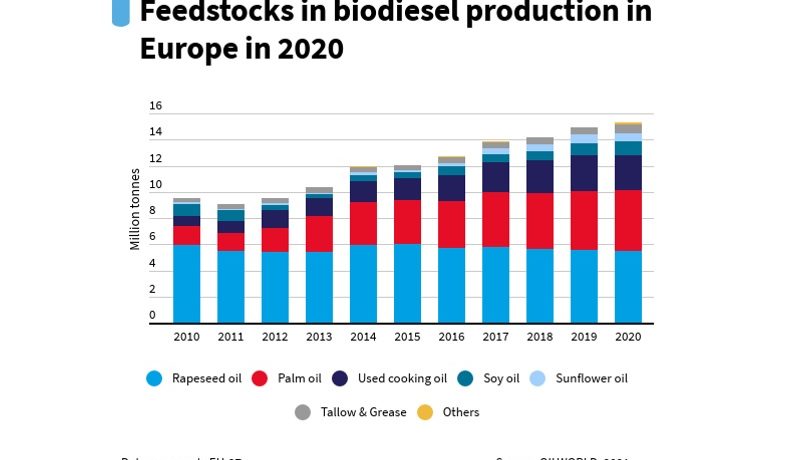
Virgin vegetable oils (rapeseed, palm, soy) made up almost 80% of the feedstock used in EU biodiesel production in 2020 and total demand for biodiesel went up, despite overall demand for fuel shrinking during the pandemic. Some European countries increased their biofuels blending, while others kept volumes constant to meet EU compliance targets. Palm oil reached its highest level, capping a decade of growth that has seen palm oil consumption treble. There was little difference in the use of rapeseed and used cooking oil (UCO), while soy volumes grew 17% and animal fats by 30% compared to 2019.
There was also a rapid increase (23%) in the share of domestically produced hydrotreated vegetable oil (HVO) in the diesel pool, which requires significantly more vegetable oil than traditional methods. The capacity for HVO production is set to almost double in the next 5 years, driven by new projects from oil majors including Total, ENI and Neste.
Laura Buffet added: “We’ve seen a big shift away from palm oil in supermarkets. Nowadays consumers can choose whether they want to buy goods tainted with palm oil. This is not the case for transport. The EU’s transport sector is currently propping up demand for ruinous palm oil without consumers knowing it. We need to phase-out palm oil biofuels immediately.”
The updated REDII, adopted in 2018, plots a path away from palm oil. Palm oil biodiesel use will be frozen at 2019 volume levels and then, from 2023, progressively phased out by 2030 in the EU’s green targets.
For T&E, this is too late and there is a risk that palm oil will simply be replaced by soy and other vegetable oils, which also drive deforestation.
Laura Buffet concluded: “While palm oil may be the worst, as history has shown, producers will simply move to what is cheap. In reality, unless we take action now palm will be replaced with soy or other virgin oils, moving the problem from one part of the world to another. Crop biofuels are not the solution for Europe’s transport and they never will be.”
[1] The yield for palm oil is 3.16 tonnes per hectare whereas for soy oil it is 0.5 tonnes per hectare. The EU’s maximum annual consumption over the last decade of these feedstocks used for biodiesel is used to calculate the amount of land, assumed to have displaced forests, resulting in 4 million hectares.
[2] 1.1 million hectares of land is required for palm plantations in what were Indonesian and Malaysian forests, the last refuge for the remaining orangutan population, estimated to be 65,000 in 2017 with a population density of 0.45 to 0.76 individuals per square kilometer.