
The EU food waste action. EU policymakers face pressure to back ambitious legally binding food waste targets.
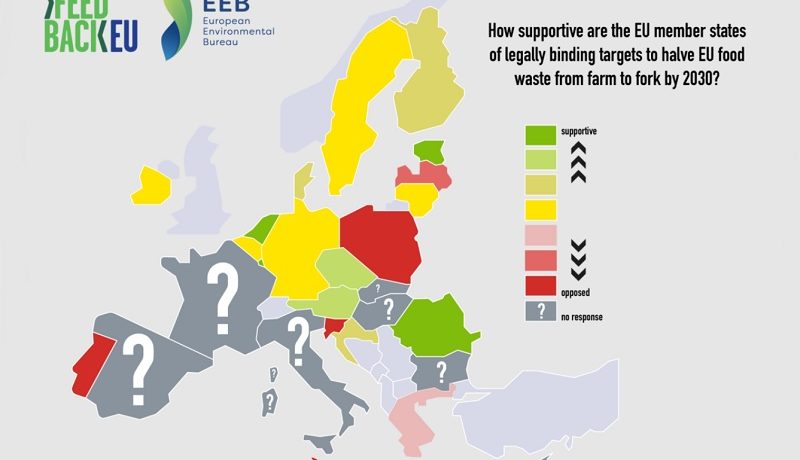
The countries supporting and opposing ambitious legally binding EU food waste targets have been revealed, according to a survey of EU member state positions published today by Feedback EU and European Environmental Bureau (EEB).
Campaigners have praised Romania, the Netherlands, Luxembourg, and Estonia for “leading the world” by expressing support for the introduction of legally binding targets for member states to reduce EU food waste by 50% from farm to fork by 2030. Other member states like Austria, Denmark, the Czech Republic and Croatia also expressed support for legally binding EU food waste targets, but for now stopped short of clearly back 50% farm to fork reduction by 2030.
In contrast, Poland, Malta, Slovenia and Portugal currently oppose the setting of any legally binding food waste targets for EU member states – in a move condemned by campaigners. Greece and Latvia also currently oppose setting targets at 50% or farm to fork, preferring lower targets for only limited parts of the supply chain.
Many other member states are currently remaining neutral or undecided. Findings are the result of a survey sent by Feedback EU and EEB to the Ministries in each EU member state with responsibility for food waste policy, between June-September.
The Commission is due to make a proposal for legally binding food waste targets for EU member states later this year, with formal adoption by 2023 – a decision which is influenced by consultation with EU member states. Negotiations with the European Parliament and Council will then decide on the ultimate targets – the Ministries in each country will shape the Council’s position. If adopted, this will be the first legislation of its type in the world.
48 organisations from 20 EU countries have now signed a joint statement calling on EU policymakers to introduce legally binding targets for member states to cut EU food waste from farm to fork by 50% by 2030, within scope of current reporting, and review extending reporting to cover all on-farm food waste. The signatories include NGOs Feedback EU, European Environmental Bureau and Zero Waste Europe, food waste businesses Too Good to Go and OLIO, and members of the EU Platform on Food Losses and Food Waste – the EU’s official advisory body on food waste.
It is estimated that the EU wastes 140.6 million tonnes of food each year – more food than it imports, according to a report from environmental organisation Feedback EU published in September. Food waste also costs EU businesses and households an estimated €143 billion a year, and causes at least 6% of the EU’s total greenhouse gas emissions.
Frank Mechielsen, Executive Director at Feedback EU said: “We want to praise countries like Romania, the Netherlands, Luxembourg, and Estonia for their leadership in supporting legally binding targets to halve EU food waste from farm to fork by 2030. At a time of high food prices and growing climate crisis, while the EU is potentially throwing away more food than it’s importing, it’s vital that the Commission and other EU countries follow their lead. It’s shameful that countries like Poland, Malta, Slovenia and Portugal currently oppose targets on food waste. We urge countries who are still undecided to get behind this common-sense legislation. Halving food waste across the supply chain by 2030 is a huge opportunity to tackle climate change and improve food security, and setting a weaker target would be planning to fail to meet Sustainable Development Goal 12.3. And opting for a retailer-and-consumer-only food waste target would mean that between 38-75% of total EU food waste, including from farms, processing and food service, would be excluded.”
Piotr Barczak, Senior Policy Officer at European Environmental Bureau, said: “All EU Member States have committed in 2013 to the Sustinable Development Goals, among which SDG 12.3 commits to reducing food waste by 50% by 2030. 10 years later, many MS haven’t really progressed, but rather increased their food waste generation. Some of them quite openly oppose binding targets at EU level, or refuse to answer our legitimate civil society questions. These gevernments are not responsible.”
The European Environmental Bureau (EEB) is Europe’s largest network of environmental citizens’ organisations, standing for environmental justice, sustainable development and participatory democracy. Our experts work on climate change, biodiversity, circular economy, air, water, soil, chemical pollution, as well as policies on industry, energy, agriculture, product design and waste prevention. We are also active on overarching issues such as sustainable development, good governance, participatory democracy and the rule of law in Europe and beyond.
We have over 180 members in over 38 countries.