
Category: Operations
Financial-Non-financial reporting frameworks share common founding principles of transparency and accountability. The world’s leading financial and non-financial corporate reporting frameworks have the same common foundations, based on the key objectives of transparency and accountability, according to a position paper published by the framework providers today. The position paper sets out the seven key principles report preparers should follow for achieving such transparency and accountability.
Participants of the Corporate Reporting Dialogue – an initiative convened by the International Integrated Reporting Council bringing together the major international reporting frameworks – identify transparency and accountability as critical to achieving high quality governance mechanisms and empowerment of stakeholders in modern societies and markets.
Furthermore, such transparency and accountability enables better decision-making by market parties and serves the public good.
In the paper, entitled “Understanding the value of transparency and accountability”, CDP, the Climate Disclosure Standards Board, the Global Reporting Initiative, the International Accounting Standards Board, the International Integrated Reporting Council, the International Organization for Standardization and the Sustainability Accounting Standards Board set out seven principles of transparency and accountability that they commonly believe are fundamental to corporate reporting: materiality, completeness, accuracy, balance, clarity, comparability and reliability.
The paper states, “These common principles are a reminder that the Dialogue participants have similar expectations from companies in preparing and disclosing information. This implies an alignment at the fundamental level of the frameworks.“
The position paper acknowledges a commonly agreed need for companies to go beyond disclosure and demonstrate accountability to stakeholders, stating, “…transparency needs accountability in order to drive effective behaviour or performance: disclosing in itself is not enough if those holding to account do not have the power to influence the behaviour or performance.”
Participants of the Dialogue have committed to promoting the application of these principles for the wider reporting landscape in future interactions or partnerships, as part of their commitment to providing greater clarity to the reporting landscape on how to use the individual frameworks of Dialogue participants to achieve effective, holistic reporting.
The seven transparency and accountability principles that Dialogue participants commonly believe are fundamental are outlined below.
In addition, each individual framework has its own unique principles that may not be present in (all) other frameworks.
The brief descriptions included are not to be seen as the common definitions by the Dialogue, but only serve the purpose of briefly clarifying the principles:
– Materiality: this regards relevant information that is (capable of) making a difference to the decisions made by users of the information.
– Completeness: all material matters identified by the organisation for the relevant topic(s) should be reported upon.
– Accuracy (free from material error): the information reported should be free from material error.
– Balance (neutral): the information does not have bias, i.e. is not presented in such a way that the probability would be increased that it will be received favourably or unfavourably by the users.
– Clarity: the information will be understandable and accessible to the users; this includes a certain level of conciseness.
– Comparability, including consistency: information is reported on the same basis and applying the same methodologies year-on-year. Also, the information enables comparison against other organisations.
– Reliability: in preparing the information processes and internal controls are in place that ensure the quality of the information and allow for examination of the information reported.
About the Corporate Reporting Dialogue
The Corporate Reporting Dialogue is an initiative, convened in June 2014 by the International Integrated Reporting Council, designed to respond to market calls for greater coherence, consistency and comparability between corporate reporting frameworks, standards and related requirements.
Authors of the Corporate Reporting Dialogue Transparency and Accountability paper:
CDP is an international non-profit that drives companies and governments to reduce their greenhouse gas emissions, safeguard water resources and protect forests.
Climate Disclosure Standards Board (CDSB) is an international consortium of business and environmental NGOs, committed to advancing and aligning the global mainstream corporate reporting model to equate natural capital with financial capital.
Global Reporting Initiative (GRI) is an international independent organization that has pioneered corporate sustainability reporting since 1997. GRI helps businesses, governments and other organizations understand and communicate the impact of business on critical sustainability issues such as climate change, human rights, corruption and many others.
International Accounting Standards Board (IASB) The IFRS Foundation is a not-for-profit international organisation responsible for developing a single set of high-quality, global accounting standards, known as IFRS Standards. IFRS Standards are now required in over 140 jurisdictions, with many others permitting their use.
International Integrated Reporting Council (IIRC) is the convenor of the Corporate Reporting Dialogue. It is a global coalition of regulators, investors, companies, standard setters, the accounting profession and NGOs. The coalition is promoting communication about value creation as the next step in the evolution of corporate reporting.
International Organization for Standardization (ISO) is an independent, non-governmental international organization with a membership of 163 national standards bodies each of which represent the stakeholders in their countries. Through its members, it brings together experts to share knowledge and develop voluntary, consensus-based, market-relevant International Standards that support innovation and provide solutions to global challenges.
Sustainability Accounting Standards Board (SASB) is an independent standard-setting organization that develops and maintains robust reporting standards that enable businesses around the world to identify, manage and communicate financially material sustainability information to their investors. SASB standards are evidence based, developed with broad market participation, and are designed to be cost-effective for companies and decision-useful for investors.
Additional participant in the Corporate Reporting Dialogue:
Financial Accounting Standards Board (FASB) (FASB participates as an observer) is the independent, private-sector, not-for-profit organization that establishes financial accounting and reporting standards for public and private companies and not-for-profit organizations that follow Generally Accepted Accounting Principles (GAAP).
Citytech 2019: anteprima. La 4° rivoluzione industriale è in atto e così anche il mondo dell’automotive sta avanzando ad una velocità impressionante guidato dalla principale tendenza tecnologica degli ultimi anni: la digital transformation.
Sarà proprio questo, dunque, il fil rouge che legherà tutte le tematiche affrontate durante Citytech, l’evento B2B dedicato alla mobilità urbana più accreditato d’Italia, che raccoglie tutte le innovazioni e le best practice del settore sia a livello nazionale che internazionale, diventando così un momento di incontro e discussione per aziende leader, startup, istituzioni, stakeholder, investitori e media.
Come ogni anno, Citytech si aprirà con la Sessione Istituzionale Plenaria in cui le principali autorità istituzionali e governative illustreranno le novità e i progressi portati avanti in Italia nell’ultimo anno.
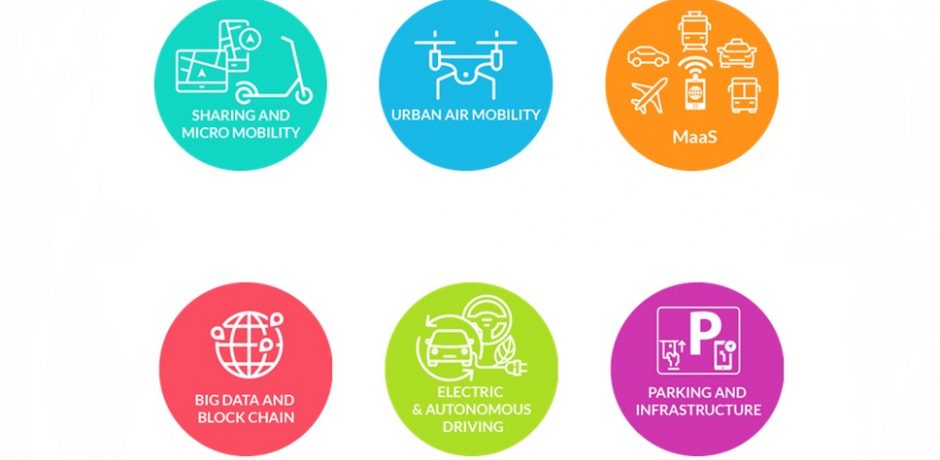
Il viaggio di Citytech alla scoperta della Digital Transformation proseguirà poi con il susseguirsi di diversi workshop tecnici che avranno come argomento:
Il service design di oggi
– scenari attuali e futuri del rental, pooling, ride hailing, sharing e trasporto pubblico.
Il service design del primo ed ultimo miglio
– dai primi risultati ottenuti con i servizi dedicati alla micromobilità
– allo sviluppo di un trasporto merci elettrico e più sostenibile.
Il service design del futuro
– il potenziale della Urban Air Mobility, uno dei sistemi più sicuri ed efficaci
– per il trasporto aereo di passeggeri e merci in ambito urbano.
I pagamenti digitali
– soluzioni innovative per il pagamento della sosta e del TPL
– grazie all’utilizzo di big data, connettività e blockchain.
Il rapporto con l’utente
– le nuove esigenze della community tra controlli e sanzioni più efficienti
– per ottenere un servizio migliore e alla portata di tutti.
Organizzato con il Comune di Milano, Citytech giunge alla sua settima edizione e verrà ospitato da Milano LUISS HUB il 20 e 21 novembre 2019.
– BYinnovation è Media Partner di Citytech
Solar, Wind, Batteries to Attract $10 Trillion to 2050, but curbing emissions long-term will require other technologies too. Deep declines in wind, solar and battery technology costs will result in a grid nearly half-powered by the two fast-growing renewable energy sources by 2050, according to the latest projections from BloombergNEF (BNEF).
In its New Energy Outlook 2019 (NEO), BNEF sees these technologies ensuring that – at least until 2030 – the power sector contributes its share toward keeping global temperatures from rising more than 2 degrees Celsius. (Importantly, major progress in de-carbonization will also be required in other segments of the world’s economy to address climate change).
Each year, NEO compares the costs of competing energy technologies through a levelized cost of energy analysis. This year, the report finds that, in approximately two-thirds of the world, wind or solar now represent the least expensive option for adding new power-generating capacity. Electricity demand is set to increase 62%, resulting in global generating capacity almost tripling between 2018 and 2050.
This will attract $13.3 trillion in new investment, of which wind will take $5.3 trillion and solar $4.2 trillion. In addition to the spending on new generating plants, $840 billion will go to batteries and $11.4 trillion to grid expansion.
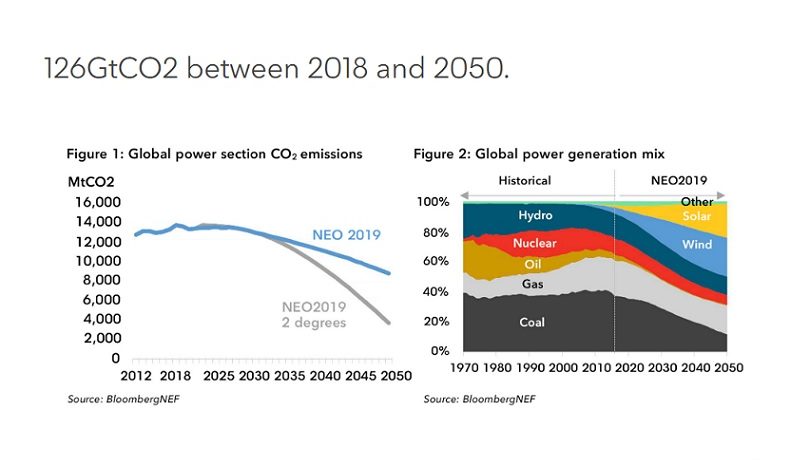
NEO starts by analyzing technology trends and fuel prices to build a least cost view of the changing electricity sector. The results show coal’s role in the global power mix falling from 37% today to 12% by 2050 while oil as a power-generating source is virtually eliminated. Wind and solar grow from 7% of generation today to 48% by 2050.
The contributions of hydro, natural gas, and nuclear remain roughly level on a percentage basis.
Matthias Kimmel, NEO 2019 lead analyst, said: “Our power system analysis reinforces a key message from previous New Energy Outlooks – that solar photovoltaic modules, wind turbines and lithium-ion batteries are set to continue on aggressive cost reduction curves, of 28%, 14% and 18% respectively for every doubling in global installed capacity. By 2030, the energy generated or stored and dispatched by these three technologies will undercut electricity generated by existing coal and gas plants almost everywhere.”
The projected growth of renewables through 2030 indicates that many nations can follow a path for the next decade and a half that is compatible with keeping the increase in world temperatures to 2 degrees or less. And they can do this without introducing additional direct subsidies for existing technologies such as solar and wind.
“The days when direct supports such as feed-in tariffs are needed are coming to an end,” said Elena Giannakopoulou, head of energy economics at BNEF. “Still, to achieve this level of transition and de-carbonization, other policy changes will be required – namely, the reforming of power markets to ensure wind, solar, and batteries are remunerated properly for their contributions to the grid. NEO is fundamentally policy-agnostic, but it does assume that markets operate rationally and fairly to allow lowest-cost providers to win.”
Europe will decarbonize its grid the fastest with 92% of its electricity supplied by renewables in 2050. Major Western European economies in particular are already on a trajectory to significantly decarbonize thanks to carbon pricing and strong policy support. The U.S., with its abundance of low-priced natural gas, and China, with its modern fleet of coal-fired plants, follow at a slower pace.
China sees its power sector emissions peaking in 2026, and then falling by more than half in the next 20 years. Asia’s electricity demand will more than double to 2050. At $5.8 trillion, the whole Asia Pacific region will account for almost half of all new capital spent globally to meet that rising demand. China and India together are a $4.3 trillion investment opportunity.
The U.S. will see $1.1 trillion invested in new power capacity, with renewables more than doubling its generation share, to 43% in 2050.
The outlook for global emissions and keeping temperature increases to 2 degrees or less is mixed, according to this year’s NEO. On the one hand, the build-out of solar, wind and batteries will put the world on a path that is compatible with these objectives at least until 2030. On the other hand, a lot more will need to be done beyond that date to keep the world on that 2 degree path.
One reason is that wind and solar will be capable of reaching 80% of the electricity generation mix in a number of countries by mid-century, with the help of batteries, but going beyond that will be difficult and will require other technologies to play a part – with nuclear, biogas-to-power, green hydrogen-to-power and carbon capture and storage among the contenders.
BNEF’s NEO director, Seb Henbest commented: “Our analysis suggests that governments need to do two separate things – one is to ensure their markets are friendly to the expansion of low-cost wind, solar and batteries; and the other is to back research and early deployment of these other technologies so that they can be harnessed at scale from the 2030s onwards.”
In NEO 2019, BNEF for the first time considers 100% electrification of road transport and the heating of residential buildings, leading to a significant expansion of power generation’s role.
Under this projection, overall electricity demand would grow by a quarter compared to a future in which road transport and residential heat only electrify as far as assumed in the main NEO scenario. Total generation capacity in 2050 would have to be three times the size of what is installed today. Overall, electrifying heat and transport would lower economy-wide emissions, saving 126GtCO2 between 2018 and 2050.
NEO 2019 is the result of a detailed study of the outlook for energy demand and supply, country-by-country, conducted by 65 BNEF analysts around the world. It draws on BNEF’s market-leading work on the evolving economics of different generation sources.

Responsible investment and sustainable development growing priority for private equity finds PwC survey. Responsible investment – involving the management of environmental, social and governance (ESG) issues – is an increasingly significant consideration for both private equity houses (general partners – GPs) and investors (limited partners – LPs), according to a new survey released today by PwC.
The Private Equity Responsible Investment Survey 2019 draws upon the views of 162 respondents from 35 countries/territories, including 145 PE houses. This is the fourth edition of the survey, following on from previous editions in 2016, 2015 and 2013.
The 2019 survey has found that nearly 81% of respondents are reporting ESG matters to their boards at least once a year, with a third (35%) doing so more often. Almost all (91%) report having a policy in place or in development, compared to 80% in 2013. Of these, 78% are using or developing KPIs to track, measure and report on progress of their responsible investment or ESG policy.
Most strikingly, 35% of respondents reported having a team dedicated to responsible investment activity (an increase from 27% in 2016). Of those without a specific function, 66% rely on their Investment/Deal teams to manage ESG matters.
Meanwhile, two thirds (67%) of respondents have identified and prioritised SDGs that are relevant to their investments (compared to 38% in 2016) and 43% have a proactive approach to monitoring and reporting portfolio company performance against the SDGs (up from 16% in 2016).
Will Jackson-Moore, Global Private Equity, Real Assets and Sovereign Fund Leader at PwC, says: ‘This is a really encouraging survey that suggests responsible investment is starting to come of age in terms of driving sustainable business practice. The private equity sector has a vital role to play in supporting sustainable development: the survey highlights that private equity houses and LPs are taking that responsibility seriously and driving genuine change. That is especially important as their role in global capital markets increases.
It is heartening to see that responsible investment is seen as a matter for those at the heart of the investment process and needs to be supported by rigorous monitoring and reporting. LPs are playing a vital role in applying pressure to act on key areas of ESG concerns and in influencing board agendas.
Yet while responsible investment may only be at the ‘young adult’ stage of development, these are signs of increasing maturity.’
Even so, the survey also acknowledges a continued distance between those considering action, and those taking proactive steps. For instance, while 89% of respondents cite cyber and data security as a concern, only 41% are taking action. Similarly, 83% are concerned by climate risk for their portfolio companies, yet only 31% have acted upon this.
Will Jackson-Moore adds: ‘There is a risk of “impact-washing” – where it is claimed that investments have a greater SDG-aligned contribution or positive impact than can be evidenced, or using positive examples of responsible investment to divert attention from other investments where less action has been taken. Yet investors and PE leaders have a role to play in continuing to influence responsible investment behaviour, through demanding more robust and granular reporting around ESG matters. For instance, PwC UK has worked with the well-respected global initiative The Impact Management Project to develop an impact assessment framework based on the SDGs, to support investors. We are at the stage that we can see ESG genuinely driving returns, and enhanced ESG practices can potentially enhance multiples: it may well be the next big value lever.
It is therefore vital for PE houses and investors alike to recognise that even if responsible investment may seem challenging there are numerous solutions and frameworks that can be applied to achieve positive outcomes.’
PwC carried out the survey in September – October 2018 through an online questionnaire. To track the simultaneous maturity of responsible investment in both stakeholder groups, we surveyed LPs and GPs together for the first time. We received responses from 162 participants (124 were GPs, 17 were LPs and 21 were both GPs and LPs) from 35 countries and territories, making it our largest collective sample to date.
The survey asked many of the same questions we have asked our GPs and LPs in previous surveys, to allow for comparison over time. However, it also allowed us to compare and contrast responses from GPs and LPs to the same questions, so as to identify any similarities or differences in approach, which we have highlighted in the report. It also included questions on new thematic areas, like climate risk.

Recyclability rigid packaging. Manufacturers urged to adopt new guidelines for recyclability of household rigid packaging. WRAP, which manages The UK Plastics Pact, has published guidance that sets out which plastics used in household packaging are currently classed as ‘recyclable’. It provides direction to packaging designers and specifiers, setting out a ‘best in class’ vision for design, including targets for recycled content.
Through consultation with industry, WRAP has identified what types of plastic packaging are actually recycled, at scale and in practice, and are therefore defined as ‘recyclable’. The On-Pack Labelling Scheme (OPRL) is anticipated to adopt what is classed as ‘recyclable’ under The UK Plastics Pact when it updates its guidance later in 2019.
The document highlights a preference for clear PET (often used for drinks bottles and trays), on the basis that the end market for this material is significantly higher and by using ‘clear’, there is the greatest potential for it to be used back, ideally into plastic packaging.
When it comes to colour, only those that can be sorted in the recycling processes using near-infra red technology will be deemed recyclable. WRAP plans to publish further guidance on this in the coming months, specifically in relation to new near-infra-red (NIR) detectable black plastics.
Peter Maddox, Director of WRAP UK, launched the guidance at today’s Packaging News Environmental Packaging Summit and said: “If plastic is recyclable, and clearly labelled as such, we stand a far greater chance of keeping that plastic in the economy and out of the natural environment. We also know from recent research that citizens want to see packaging that is 100% recyclable, which they can recycle at home.* By rationalising the number of polymers used in packaging, we can develop a more efficient recycling system, and reduce confusion for citizens.
“Through The UK Plastics Pact we are working at pace with our members to respond to this, and ensure that all plastic packaging is re-usable, recyclable or compostable by 2025. This new guidance is a significant milestone in our journey towards reaching that target.
“Businesses that specify, design and produce plastic packaging will be able to draw on this resource for best practise guidance in selecting plastic polymers which are recyclable, while retaining the important protective properties that packaging has. While some plastics are classed as recyclable, there is a need to move beyond this, ideally selecting polymers which have a greater recyclability potential than others. In doing so it will help us to achieve other Pact targets, notably to achieve an average of 30% recycled content across all pack formats.”
Users of the guidance will find ‘best in class’ polymer choices for individual packaging types to guarantee recyclability. For example, for plastic food and drink bottles, the guidance explains:
– Best in class material choice – for the bottle, cap and sleeve
– Best in class colour choice
– Labelling recommendations
– The rationale behind these recommendations
While the scope of the guidance is currently rigid plastic packaging – bottles, pots tubs and trays – it will be updated in the future to include films and flexibles.
The classifications of what is recyclable do not yet include compostable plastics. WRAP believes similar principles should be applied to these types of plastics, with a need to demonstrate that the materials are actually composted in current infrastructure. Further guidance on this is expected over the summer.
Companies fail to disclose impact on world’s forests. A large majority of major corporations are failing to be transparent about their impacts on global deforestation and many are taking inadequate steps to tackle it, according to a new report released by environmental non-profit CDP.
Over 1,500 companies deemed to have a significant impact on deforestation or to be susceptible to deforestation risk were requested by investors and large purchasing organizations to disclose forests data through CDP’s reporting platform in 2018, but 70% failed to do so. Companies are asked to disclose on four commodities linked to deforestation: timber, palm oil, cattle and soy.
Over 350 companies have declined to respond for the last three years (2018-2016), including major consumer facing brands like Dominos, Next, and Sports Direct along with global food corporation Mondelez and its palm oil supplier Rimbunan Hijau Group, the largest palm oil company in the rainforest region of Sarawak, Malaysia.
These companies use commodities that drive deforestation, for example through their procurement of palm oil for inclusion in chocolates, leather for shoes, paper for pizza boxes and timber for furniture – as forests are cleared for cattle ranching, plantations or agriculture.
CDP’s new report, The Money Trees, finds that corporate transparency on forests (30% disclosure rate in 2018) lags behind other environmental issues such as climate change and water security (both 43%). This is despite significant risks to business from deforestation, the ecological importance of forests and the role they must play in solving climate change, as well as the heightened environmental concern among investors, buyers and consumers.
Morgan Gillespy, Global Director of Forests at CDP, commented: “The silence is deafening when it comes to the corporate response to deforestation. For too long corporations have ignored the impacts of their supply chains on the world’s forests and have not taken seriously the risks this poses – both to their business and the world.
Environmental concern is at an all-time high, and companies are being demanded to be transparent and take decisive action to protect forests. Consumers increasingly want to know that their shopping basket isn’t driving the destruction of the Amazon, extinction of the orangutans and the climate crisis.
Businesses that want to maintain market share need to listen to the calls from their customers, investors and consumers – or they could face a backlash. Companies are already telling us reputational risk is the top risk they see from deforestation and this is likely to become ever more prominent as sustainable consumption trends continue and the market shifts”.
A total of 306 companies disclosed forests data to CDP in 2018, reporting on their sourcing of timber, palm oil, cattle and/or soy and the actions taken to reduce deforestation in their supply chains.
Analyzing these companies’ responses, the report reveals the level of action is insufficient to solve the problem of deforestation. This is despite damage to brand reputation from links to deforestation being the most frequently cited risk in the report.
Around a quarter (24%) of companies are either taking no or limited action on deforestation, for example by focusing on only one commodity instead of all commodities within their supply chain.
The data also shows over a third of companies are not yet working with their suppliers to reduce deforestation. This is a critical gap as deforestation is almost always a supply chain issue, unless the company is a direct producer.
Companies report a potential US$30.4 billion in losses due to the impacts of deforestation risks, such as brand damage, regulatory change and physical impacts like forest fires and crop failures.
Yet this is only the tip of the iceberg, as only around a quarter of companies reported financial figures for potential losses. The data also shows that nearly a third of companies do not even include forest-related issues in their risk assessments. However, among companies that do, almost all (92%) see substantial risks, suggesting that the business risks and financial impacts associated with deforestation are underreported.
Nearly 450 companies1 and more than 50 governments2 have pledged to end deforestation by 2020, but industry action to date has not been enough to achieve this, with companies recently publicly stating that this deadline will be missed3. Global forest loss continues at a rate of 5 million hectares a year or 15 football pitches every minute4. Turning this trajectory around is essential to address the climate crisis, with the IPCC’s special report on 1.5°C highlighting the need to use forests as carbon sinks.
Yet CDP data shows 83% of corporate targets on deforestation end in 2020 and only 14% extend beyond, posing the risk of corporate action on deforestation falling off a cliff next year.
However, CDP’s report also finds there are some companies leading the way, implementing numerous actions including engaging with their suppliers on the protection of forests. For example, global beauty giant L’Oréal and German consumer goods manufacturer Beiersdorf AG are leading on the sustainable sourcing of palm oil. To encourage its suppliers to manage their forest footprint, L’Oréal has developed its Sustainable Palm Index, to assess suppliers’ commitments and achievements in fighting deforestation.
CDP data shows that for the companies willing to move the needle on forests, there are major opportunities up for grabs. 76 companies reported business opportunities – such as increased brand value and product innovation – valued at US$26.8 billion, more than half of which are rated highly likely or virtually certain.
Morgan Gillespy, Global Director of Forests at CDP, added: “Our data shows companies are not doing enough to end deforestation. Meanwhile the hundreds of high-impact companies that have not disclosed through CDP and therefore not been analyzed in this report could be missing out on lucrative opportunities. They could also be sitting on a black box of risks that their investors, customers and end consumers are not aware of, but are increasingly demanding transparency on”.
CDP is an international non-profit that drives companies and governments to reduce their greenhouse gas emissions, safeguard water resources and protect forests. Voted number one climate research provider by investors and working with institutional investors with assets of US$96 trillion, we leverage investor and buyer power to motivate companies to disclose and manage their environmental impacts. Over 7,000 companies with over 50% of global market capitalization disclosed environmental data through CDP in 2018. This is in addition to the over 750 cities, states and regions who disclosed, making CDP’s platform one of the richest sources of information globally on how companies and governments are driving environmental change. CDP, formerly Carbon Disclosure Project, is a founding member of the We Mean Business Coalition.
Il 70% delle aziende non rende pubblico l’impatto della propria attività sulla deforestazione nel mondo
La maggioranza delle grandi aziende non comunica in modo trasparente l’impatto delle loro attività sulla deforestazione globale, oltre a non adottare misure adeguate a favore della salvaguardia delle foreste. Questo è quanto emerge dal nuovo report pubblicato da CDP, la piattaforma globale di rendicontazione ambientale che ogni anno raccoglie dati ambientali da oltre 7.000 aziende.
I dati rivelano che sono oltre 1.500 le aziende che hanno un impatto significativo sulla deforestazione o che possono incorrere nel rischio di deforestazione ambientale e che nel 2018 sono state invitate da investitori e grandi organizzazioni di acquisto per comunicare informazioni circa l’attenzione alle foreste attraverso la piattaforma di reporting di CDP. Ciò nonostante, il 70% non l’ha fatto, rifiutando di fornire maggiori dettagli sui principali elementi responsabili della deforestazione: legno, olio di palma, allevamenti di bestiame e soia.
Tuttavia, più di 350 aziende hanno rifiutato di rispondere sul triennio 2018-2016, tra cui i principali marchi di consumo come Dominos, Next, Ferrero Spa e Sports Direct insieme alla multinazionale americana attiva nel settore alimentare Mondelez e il suo fornitore di olio di palma Rimbunan Hijau Group, leader nella regione della foresta pluviale del Sarawak, in Malesia.
Infatti, queste aziende utilizzano ampiamente prodotti che figurano tra i principali responsabili della deforestazione. A titolo di esempio si può citare l’acquisto di olio di palma per realizzare i cioccolatini, così come il cuoio per le scarpe, la carta per le scatole della pizza e il legno per i mobili. A ciò si aggiunge che le aree forestali vengono continuamente messe a rischio dall’allevamento intensivo di bestiame, ma anche dall’agricoltura stessa.
Il nuovo rapporto di CDP rivela che la trasparenza aziendale sulla deforestazione (con un tasso di divulgazione del 30% nel 2018) è in netto ritardo rispetto ad altre questioni ambientali come il cambiamento climatico e la sicurezza idrica (entrambe stabili al 43%). L’importanza di preservare le foreste non è fondamentale solo per scongiurare danni di business a livello aziendale, bensì anche come strumento risolutivo per combattere il cambiamento climatico e rassicurare le crescenti preoccupazioni di investitori, acquirenti e consumatori.
Morgan Gillespy, Global Director of Forests at CDP, ha commentato, “Il silenzio è assordante quando si tratta delle misure aziendali nei confronti della deforestazione. Per troppo tempo le aziende hanno ignorato l’impatto delle loro catene di approvvigionamento sulle foreste esistenti, senza prendere sul serio i rischi che ne derivano – sia lato business sia sulla società globale.
Attualmente, la preoccupazione per l’ambiente è ai massimi livelli e le aziende hanno il dovere di essere trasparenti e intraprendere azioni decisive per la salvaguardia delle foreste. Di pari passo, i consumatori si mostrano sempre più sensibili a questo tema e desiderosi di sincerarsi che nel loro carrello non ci siano prodotti responsabili della deforestazione dell’Amazzonia, dell’estinzione degli oranghi e del cambiamento climatico.
Le aziende che mirano a mantenere una quota di mercato devono ascoltare i loro clienti, investitori e consumatori, così da non rischiare di incappare in situazioni sfavorevoli. Le aziende, infatti, suggeriscono che il rischio reputazionale è il rischio maggiore che può derivare da una mancata attenzione nei confronti della deforestazione, un tema destinato ad acquisire sempre più importanza a seconda del cambiamento del mercato e dei consumi in un’ottica sostenibile”.
Nel 2018 un totale di 306 aziende ha collaborato con CDP condividendo i propri rapporti di sostenibilità fornendo dettagli sulla provenienza di legno, olio di palma, bestiame e / o soia, indicando le misure intraprese per combattere la deforestazione all’interno delle loro catene di approvvigionamento.
Analizzando le risposte di queste aziende, il report rivela che le iniziative sono insufficienti per risolvere il problema della deforestazione. Tuttavia, è interessante osservare come il danno reputazionale del brand derivante dalla deforestazione sia indicato come il rischio di gran lunga più frequente.
Circa un quarto (24%) delle società non intraprende affatto o adotta misure circoscritte per combattere la deforestazione, ad esempio concentrandosi su una singola categoria merceologica senza rendere più sostenibile le altre merci che attraversano la propria catena di approvvigionamento.
I dati confermano, inoltre, che oltre un terzo delle aziende non sta lavorando con i propri fornitori al fine di ridurre il proprio impatto ambientale sulle foreste. Ciò è emblematico di un divario critico, in quanto la deforestazione è quasi sempre un problema di filiera, ad eccezione di quei casi in cui la società sia un produttore diretto.
Complessivamente, le aziende riportano perdite potenziali per un valore di 30,4 miliardi di dollari dovute all’impatto dei rischi da deforestazione, tra cui danni reputazionali, cambiamenti normativi e catastrofi naturali come incendi e cattivi raccolti.
Eppure, tutto ciò è solo la punta dell’iceberg, in quanto circa un quarto delle aziende prevede una stima quantitativa delle potenziali perdite. Inoltre, i dati mostrano che quasi un terzo delle aziende non include le problematiche relative alla deforestazione nel processo di valutazione del rischio. Tuttavia, tra le aziende che ne prendono atto, quasi tutte (92%) confermano rischi sostanziali, suggerendo che il rischio aziendale e l’impatto finanziario associati alla deforestazione siano sottostimati.
Sono quasi 450 le aziende e più di 50 i governi che si sono impegnati a porre fine alla deforestazione entro il 2020, ma l’azione del settore fino ad oggi non è stata sufficiente nel raggiungimento di questo obiettivo, con realtà che già hanno dichiarato pubblicamente l’impossibilità di rispettare questa deadline . La deforestazione continua ad un ritmo di 5 milioni di ettari all’anno (equivalenti a 15 campi da calcio ogni minuto ). Invertire questa tendenza è essenziale per affrontare i problemi associati al cambiamento climatico. Ad esempio, il report dell’IPCC sull’1,5°C evidenzia la necessità di utilizzare le foreste come pozzi di assorbimento del carbonio.
Tuttavia, i dati di CDP mostrano che l’83% degli obiettivi aziendali sulla deforestazione hanno come scadenza il 2020 e solo il 14% si estende oltre questa data, facendo ipotizzare che le misure aziendali contro la deforestazione si possano esaurire nel breve termine.
Un altro dato interessante che emerge dal rapporto di CDP è che ci sono alcune aziende all’avanguardia che promuovono diverse iniziative a sostegno delle foreste grazie ad un’intensa collaborazione con i propri fornitori. Ad esempio, il colosso mondiale della bellezza L’Oréal e il produttore tedesco di beni di consumo Beiersdorf AG sono leader nell’approvvigionamento sostenibile dell’olio di palma. Per incoraggiare i propri fornitori a gestire l’impronta forestale, L’Oréal ha sviluppato Sustainable Palm Index con l’obiettivo valutare l’impegno e i risultati ottenuti dai fornitori nella lotta alla deforestazione.
Infine, i dati di CDP mostrano che per le aziende disposte a prestare maggiore attenzione alla salvaguardia delle foreste ci sono maggiori possibilità di crescita. 76 aziende hanno infatti segnalato opportunità di business come l’aumento del valore del marchio e l’innovazione di prodotto – valutate per un totale di 26,8 miliardi di dollari, di cui la metà di questo valore è dato come altamente probabile o, addirittura, certo.
Morgan Gillespy, Global Director of Forests at CDP, ha aggiunto: “I nostri dati rivelano che le aziende non stanno facendo abbastanza per porre fine alla deforestazione. Nel frattempo, sono centinaia le aziende ad alto impatto ambientale che non hanno consentito a CDP l’accesso ai loro dati e, pertanto, non sono state analizzate in questo report, eventualmente perdendo anche enormi opportunità di business. In altre parole, è come starsene comodamente seduti su una bolla pronta a scoppiare senza che i propri investitori, clienti e consumatori finali ne siano a conoscenza, pur richiedendo sempre maggiore trasparenza”.
CDP è un internazionale non-profit che spinge le aziende ed i governi a ridurre le loro emissioni di gas serra, tutelare le risorse idriche e proteggere le foreste. Votato numero uno come fornitore della ricerca climatica dagli investitori e lavorando con investitori istituzionali con le attività di 96 trilioni di dollari, sfruttiamo il potere degli investitori e dei consumatori per motivare le imprese a divulgare e gestire i loro impatti ambientali. Oltre 7,000 imprese con oltre il 50% percento della capitalizzazione del mercato globale nel 2018 hanno comunicato dei dati ambientali attraverso il CDP. Questo si aggiunge alle oltre 750 città, stati e regioni che hanno comunicato, rendendo la piattaforma del CDP una delle fonti più ricche di informazione a livello globale su come le aziende e i governi stanno spingendo cambiamenti ambientali. Il CDP, precedentemente il Progetto Carbon Disclosure, e un membro fondatore della coalizione We Mean Business.

Rinnovabili: Decreto FER1. Gli obiettivi: incentivare la produzione di energia da fonti rinnovabili e creare migliaia di posti di lavoro.
I Ministri Luigi Di Maio e Sergio Costa hanno firmato il decreto FER1, che ha l’obiettivo di sostenere la produzione di energia da fonti rinnovabili per il raggiungimento dei target europei al 2030 definiti nel Piano Nazionale Integrato per l’Energia e il Clima (PNIEC), attraverso la definizione di incentivi e procedure indirizzati a promuovere l’efficacia, l’efficienza e la sostenibilità, sia in termini ambientali che economici, del settore.
Il provvedimento, in particolare, incentiva la diffusione di impianti fotovoltaici, eolici, idroelettrici e a gas di depurazione.
“Un grande lavoro di squadra dei due ministeri, ambiente e sviluppo economico, che darà impulso alla produzione di energia rinnovabile, creando migliaia di nuovi posti di lavoro – ha dichiarato Luigi Di Maio – e puntando alla attuazione della transizione energetica, in un’ottica di decarbonizzazione”.
“E’ una vera e propria rivoluzione copernicana, un cambio di paradigma – commenta Sergio Costa – si premia l’autoconsumo di energia per gli impianti su edificio fino a 100 kW e l’eliminazione dell’amianto, si incentiva la produzione di energia sostenibile oltre che rinnovabile. Questo decreto è una grande opportunità di sviluppo e di tutela ambientale”.
Dopo aver ottenuto il via libera della Commissione europea, il Decreto FER1 è stato inviato per la registrazione alla Corte dei Conti prima della pubblicazione in Gazzetta Ufficiale.
La sintesi del provvedimento
L’ attuazione del provvedimento consentirà la realizzazione di impianti per una potenza complessiva di circa 8.000 MW, con un aumento della produzione da fonti rinnovabili di circa 12 miliardi di kWh e con investimenti attivati stimati nell’ordine di 10 miliardi di Euro.
Con gli incentivi verrà data priorità a:
– impianti realizzati su discariche chiuse e sui Siti di Interesse Nazionale ai fini della bonifica;
– su scuole, ospedali ed altri edifici pubblici per impianti fotovoltaici i cui moduli sono installati in sostituzione di coperture di edifici e fabbricati rurali su cui è operata la completa rimozione dell’eternit o dell’amianto;
– impianti idroelettrici che rispettino le caratteristiche costruttive del DM 23 giugno 2016, quelli alimentati a gas residuati dai processi di depurazione o che prevedono la copertura delle vasche del digestato;
-tutti gli impianti connessi in “parallelo” con la rete elettrica e con le colonnine di ricarica delle auto elettriche (a condizione che la potenza di ricarica non sia inferiore al 15% della potenza dell’impianto e che ciascuna colonnina abbia una potenza di almeno 15 kW).
Cambia, inoltre, la modalità di riconoscimento del premio sull’autoconsumo: per gli impianti di potenza fino a 100 kW su edifici, sulla quota di produzione netta consumata in sito è attribuito un premio pari a 10 euro il MWh cumulabile con quello per i moduli in sostituzione di coperture contenenti amianto. Il premio è riconosciuto a posteriori a patto che l’energia auto consumata sia superiore al 40% della produzione netta.
Saranno ammessi agli incentivi solo gli impianti idroelettrici in possesso di determinati requisiti che consentano la tutela dei corpi idrici, e in base a una valutazione dell’Arpa.
Gli impianti fotovoltaici realizzati al posto delle coperture in amianto o eternit avranno diritto, in aggiunta agli incentivi sull’energia elettrica, a un premio pari a 12 €/MWh su tutta l’energia prodotta.
Impianti ammissibili
Potranno partecipare ai bandi per la selezione dei progetti da iscrivere nei registri gli impianti:
– di nuova costruzione, integralmente ricostruiti e riattivati, di potenza inferiore a 1MW;
– oggetto di interventi di potenziamento qualora la differenza tra la potenza dopo l’intervento e la potenza prima dell’intervento sia inferiore a 1 MW;
– oggetto di rifacimento di potenza inferiore a 1MW.
Sono ammessi impianti fotovoltaici esclusivamente di nuova costruzione e realizzati con componenti di nuova costruzione.
Inoltre, potranno partecipare alle procedure di registri anche aggregati costituiti da più impianti appartenenti al medesimo gruppo, di potenza unitaria superiore a 20 kW, purché la potenza complessiva dell’aggregato sia inferiore a 1 MW.
Gli impianti di potenza uguale o maggiore ai valori sopra indicati per accedere agli incentivi dovranno partecipare a procedure di asta al ribasso nei limiti dei contingenti di potenza.
In analogia, potranno partecipare alle procedure di asta anche gli aggregati costituiti da più impianti appartenenti al medesimo gruppo, di potenza unitaria superiore a 20 kW e non superiore a 500 kW, purché la potenza complessiva dell’aggregato sia uguale o superiore a 1 MW.

SmartEfficiency con Decreto Crescita, Superammortamento, Iperammortamento, Sabatini 2019. Gli imprenditori, dopo aver progettato gli impianti tecnologici per abbattere gli sprechi energetici, oggi avviano i lavori per rendere più competitive le proprie aziende. (altro…)
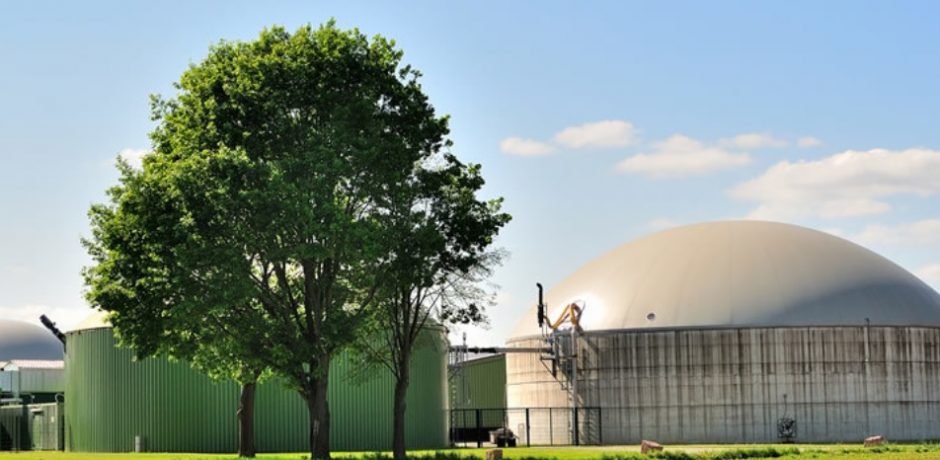
Biometano agricolo in rete nazionale. Inaugurato a Faenza il primo impianto di produzione di biometano agricolo in Italia. La cooperativa vitivinicola Caviro, socia di CIB – Consorzio Italiano Biogas, produrrà biocarburante avanzato partendo dal biogas generato con la digestione anaerobica dei sotto-prodotti del ciclo produttivo e da reflui di allevamenti della zona.
Un primo importante passo verso la decarbonizzazione del settore dei trasporti.
Piero Gattoni, presidente CIB – Consorzio Italiano Biogas dichiara: “L’immissione in rete del primo metro cubo di gas rinnovabile di origine agro-industriale è un momento storico per tutta l’agricoltura italiana. Caviro è un esempio virtuoso di coesistenza tra agricoltura e produzione di gas rinnovabile che mi auguro potrà essere presto seguito da altri. Gli investimenti delle aziende italiane del settore in attività di ricerca e sviluppo e il supporto attivo del CIB, che da sempre favorisce le sinergie e il trasferimento tecnologico tra il mondo dell’industria e quello dell’agricoltura, sta dando i risultati auspicati. Il biometano è un biocarburante avanzato che può giocare un ruolo primario nella transizione energetica e non solo. L’esempio di Caviro dimostra come la cooperazione e il modello di azienda circolare possano essere un prototipo vincente per rafforzare la competitività del settore agroindustriale e per contribuire alla decarbonizzazione del settore energetico favorendo, al contempo, la tutela ambientale”.
Il CIB – Consorzio Italiano Biogas rappresenta il comparto italiano della produzione di biogas e biometano in agricoltura e intende essere il punto di riferimento per tutto il settore.
Il CIB è la prima aggregazione volontaria che riunisce aziende agricole produttrici di biogas e biometano da fonti rinnovabili, le aziende o società industriali fornitrici di impianti, tecnologie e servizi per la produzione di biogas e biometano, Enti ed Istituzioni che contribuiscono a vario titolo al raggiungimento degli scopi sociali, di diffusione e promozione della tecnologia della digestione anaerobica per il comparto agricolo.
Il CIB, strumento tecnico voluto dai produttori per i produttori, è attivo sull’intero territorio nazionale e rappresenta tutta la filiera della produzione di biogas e biometano in agricoltura.
Il CIB è inoltre socio fondatore di EBA (European Biogas Association). Possiede pertanto il titolo per rappresentare gli interessi del settore anche a livello delle Istituzioni Europee nell’orientamento delle Direttive Comunitarie.

Illuminazione smart in CRAI Superloria. SMARTEFFICIENCY per ILLUMINAZIONE. Le esigenze principali del cliente CRAI Superloria erano di migliorare l’illuminazione del supermercato per valorizzare i prodotti in vendita a scaffale e rendere più accogliente la permanenza dei clienti nel punto vendita, oltre a diminuire marcatamente i costi energetici e di manutenzione.
(altro…)